


Nature Boy: A Journey of Birdsong and Belonging
In 2023, I was very lucky to interview Seán Ronayne for the Earth.fm podcast, where he shared a few of his incredible adventures, as well as his concerns about Ireland’s environmental health, and a fantastic segment about bird migration and mimicry.
His book is structured in such a way that learning intricate details about avian species comes as easily as following Seán’s adventures as a young boy.
Seán does a great job at describing birds’ songs and calls, but, if one is not easily distracted, I strongly recommend using an app like Merlin or a website like Xeno-Canto to hear the birds mentioned. Though I read most of the book, I also got to listen to parts of the audio version, which Seán reads himself, and which includes short recordings of featured birds.
You could also use similar resources to view photos – though the book includes beautiful illustrations by Rob Vaughan.
The book progresses chronologically from infancy to the present day, intertwined with Seán’s deep reflections and observations about his life. As a reader, I felt that I was growing with him. Despite never having visited Ireland, his vivid and highly visual descriptions demonstrate his capacity for impressively detailed recollections based on sensorial experiences.
“The midsummer sun fractured through the deciduous foliage and threw a wonderful display of green hues interspersed with beams of golden light onto the roadway in front of us. As we cruised along, windows ajar, allowing the fresh summer breeze to flow through the car, Pops threw his eye up to the canopy above. A glint of excitement took over his demeanour.”
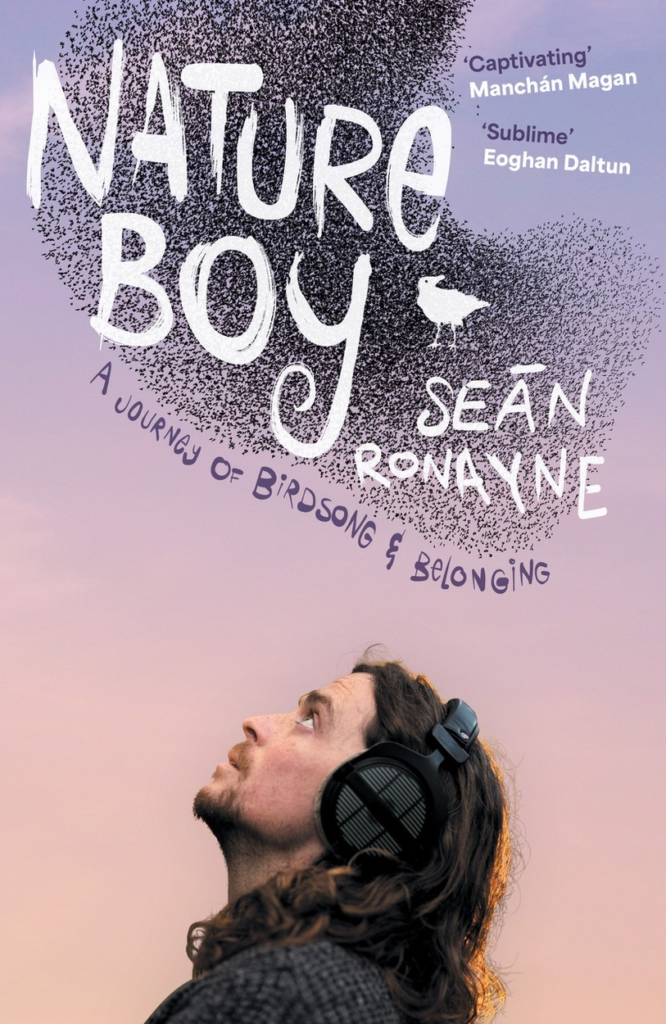
Pops, Seán’s grandfather, and Seán’s parents have been crucial in helping him to find outlets for his love for nature and immeasurable curiosity about birds. Compared to RTÉ’s award-winning documentary about Seán, Birdsong, Nature Boy is able to give much more thorough and detailed insight into these relationships and how much time they spent together in nature, intentionally observing animals: “our brilliant, wondrous comrades in life”.
Our economically driven society creates classifications for more-than-humans, defining some species as ‘invasive aliens’ in particular contexts. However, terms like this can be misleading; all eight avian species classified as invasive in Ireland arrived in the country due to human action.
However, Seán proposes referring to species such as the magpie believed to have flown to County Wexford from Wales in 1676, as “natural pioneers or colonists”. He goes on to explain the reasons why birds extend their ranges – none of which are difficult to comprehend: large-scale habitat destruction, habitat restoration, climate change, or the need to seek new resources due to population saturation in a given region.
At any given opportunity, Seán will explore common myths around certain species, with reference to studies that prove their lack of clear scientific basis.
“Why do we vilify nature? Why call wildflowers ‘weeds’ or refer to certain species as ‘pests’? This is all undeserved language […]. Why do we fear the randomness and chaotic beauty of nature, when we are too part of this beautiful mess?”
Here and there, Seán calls attention to our anthropocentrism and the sickness of our economic system. But he also makes sure to note that birds learn, react, socialize, and survive – both as species and individuals – just as humans do.
Something else that prevails in our westernized bias, and that Seán draws attention to, relates to female birdsong, and the way that, “Sometimes we listen to what we expect to hear.” An example that is familiar across the world: barn swallows. Despite a high number of studies of the species, it is males that sing the species’ chattery, cute songs.
Birdsong is thought to be among the most complex of sounds produced by any animal. The songs of different species differ in function and show great variation of duration, repertoire size, repetition, number of elements, and even of their tendency to share songs. Types of songs include babble, soft, and whisper songs.
Around 2019, having been blown away by spring dawn choruses in Swedish forests, I wanted to learn more about birdsong, but, without any training or education on the subject, I was simply lost and overwhelmed. Why don’t schools teach at least the bare minimum about the species surrounding us?
“I might be anthropomorphising, but […] [a]fter all, who are we to think or claim we are the only species who experience love, tenderness, passion, joy and fun?”
This is a point frequently brought up in the book (as well as in Birdsong and on Seán’s social media): the many ways that industrializing the management of fields, farming, and raising livestock has led to the decline or disappearance of a number of species, such as ground-nesting quail and corncrakes. This is later contrasted with non-intrusive methods of farming in Catalonia and Nepal – both of which Seán retells through his memories as having a much deeper relationship with nature than Irish agriculture.
Seán describes himself as having been a high-spirited, curious, scrupulously honest child with no-filter, who “frequently g[ot] in[to] trouble”. He recalls, “I just said and did things the other kids knew not to. I’d call my classmates names, take their stuff and generally said things that were out of line. But I didn’t know they were out of line.”
Though this retelling of Seán’s misfit behavior could be seen as amusing, his reflection has a more serious implication. Was he a misfit as a child? This is how he felt – and, who knows, other children around him likely did too – but, looking back, he has a different interpretation: “I didn’t get in trouble with nature; I was part of it. […] I listened attentively to what nature had to say. But in school back then, things were seen differently.”
A fundamental point I’d like to emphasize is the need for education about nature in schools – something that Seán sometimes brings up on his social media. So many of Ireland’s native species have been depleted and destroyed, taking away entire future generations’ opportunities to enjoy them, to say nothing of the knock-on effects on the broader ecosystem. He describes an entire class he visited that had never experienced a dawn chorus.
Another point that demands serious reflection is how many people, when enjoying nature, don’t know how to interact with it – or when not to. I remember someone I know, who had two small children, defending marine zoos because it made his sons so happy to see dolphins performing. Is this the kind of relationship to wildlife that we want our children to grow up with? The idea that animals exist for our entertainment and financial benefit? That we remove them from their native habitat and imprison them in tanks and cages? Let us instead cultivate relationships of love, self-agency, and respect.
One of the aspects I find interesting about Seán’s writing is that so much of it seems to relate to his genuine and insatiable curiosity.
However, despite this immense love for nature, Seán does not romanticize it or paint a picture of unrealistic harmony. Since his childhood he knew that some birds lose their life to others birds, recalling seeing small, fluffy cygnets being taken by grey herons and a hooded crow. Yet his father taught him not to interfere, because that’s “simply the way it is”.
The sound of a seabird colony isn’t what you’d call peaceful or melodic. It is the hustle and bustle of a hectic but thriving community. Guillemots gurgle, razorbills grunt, kittiwakes announce their names with glee. It’s a lot to take in, but it’s an orchestra of sounds to be cherished. Let’s hope our cliffs never fall silent; if they do, we are all in deep trouble.
This book also tells us about determination: after a frightening near-death experience at just 18, Seán became even more committed to what he wanted to dedicate his life to. This persuaded him to study birds even more deeply than before.
Despite the vast knowledge Seán already had at that point, he was – and continues to be – extremely meticulous when observing, studying, and registering anything about birds. While working at a part-time job, peeking through the window he would photograph birds and, with the help of a Collins Bird Guide, use various intricate details and particularities to establish which species he was looking at.
Whether it’s his work experience in a pub – a situation full of overwhelming sensorial information – or the rich descriptions of everything he saw, heard, and felt during boat trips with his father to places such as Cape Cod, Seán’s impressive, flavorful storytelling takes us into both his inner and outer worlds, which often blend together.
There are many descriptions of Seán looking out of the window – not exactly as an escape from whatever was going on inside, but as a way to access what he loved and felt he was meant to do. I’ve known someone like this – chances are, most of us do: the kid who didn’t find the school structure or its subjects even the tiniest bit appealing; the kid who was always looking out the window, spotting birds, or wondering if it was the wind that made the trees’ leaves dance.
Who do these kids grow into? And what led them there? Do they fit nicely into the system, or do they still not conform?
Nature Boy includes a very candid insight into Seán’s path, and his doubts and fears – from the moment he started school, and which persisted into his 30s. Despite a notable consistency in his nature studies, outside school and throughout his academic life, and including the cacophonous spaces where he worked in order to support his studies, he questioned the expectations against which most of us measure ourselves: a stable career or job, a life partner, a car. To me, it is tragic that so many brilliant people out there, just like Seán, feel that they are outsiders for their whole lives because they don’t fit into those parameters. And yet, they are often the most inspiring, capable, and original people I’ve met.
“Was I failing? Was this my fault? Had I spent too much time following what I loved instead of something that would give me stability? All my life I had grown up feeling different. I didn’t like the things that everyone else liked and I found social life so difficult. Had these differences, the very things that made me stand out as an oddball growing up, now manifested themselves in another manner in adulthood, a manner that meant I wasn’t hitting the life milestones that my friends were?”
It was only later that Alba, Seán’s partner, suggested that he could be on the autism spectrum. This was confirmed through medical diagnosis, and it’s very touching to read about someone finding out something so fundamental about themselves which had always been there, but had been difficult to delimitate – yet while still remaining the same person.
As a recently diagnosed ADHD-brain myself, this was particularly emotional to read; though not part of the autism spectrum, I completely understand the weight lifted off of Seán’s shoulders by his diagnosis. Suddenly, there is an explanation. And the book includes a plea for people to be more understanding of the complications of being on the spectrum; to stop diminishing it (even if the intention is to be comforting) as if it’s more widely experienced than it is. In this chapter, Seán describes and relates many of his traits in detail, from strict routines and methods, social discomfort and anxiety, to the impressive attention to detail which somewhat explains why he has always been drawn to nature, and particularly to birdsong. Coming to an understanding of autism spectrum disorder (ASD) has helped him to understand how certain traits can be used positively: his hyperfocus, deep obsessions, and sensitivity to intricate detail.
One last observation I’d like to share is the extraordinary drive and resilience in Seán’s life. He doesn’t hide his fears, whether meeting his partner, setting foot into a Nepalese forest inhabited by tigers, rhinos, and other wild animals, or moving to a country where he didn’t speak the language. And perhaps what’s most impressive is that all of this is described with as much humor as it is sensitivity.
Field Recording
When Seán moved with Alba to Catalonia, he started to record the sounds of the birds at the Delta del Llobregat. Personally, I find it funny how frustrated Seán was by the poor quality that his low-grade, handheld recorder produced – to the extent that he threw it in a closet for a long time. His sensitivity for the sounds of nature, in all their dynamics, was already so elevated that this recorder simply didn’t cut it.
Later on, he acquired a parabola to expand his recording capabilities – in particular, for capturing nocturnal migrations from his balcony. Naturally, this improvement took him much further, including field recording and climbing in the Pyrenees. While (as seen in Birdsong) setting up a meticulous but effective method allowed him to become familiar with the songs and calls of various birds, represented spectrogrammatically, accelerating the process of analysing and cataloguing species recorded in particular soundscapes. This becomes particularly interesting in chapter 14, regarding the common whitethroat, a bird which Seán finds fascinating – for good reason – due to its jaw-dropping mimicry.
His methods in the field have also evolved and include marking locations on a map, running passive recorders for several weeks at a time, and setting up hidden recording rigs.
“I now had ‘our’ whitethroats singing their roadmap in life. They were telling me who they spent their time with on the Irish breeding grounds, who they met on their travels through Iberia and, most amazingly, who they heard way down in subtropical Senegal on their winter vacations. These birds were singing their life stories to me. These tales from their epic migratory routes were like stamps on a passport. It gave me chills just thinking about it. What a beautiful, intimate representation of these birds’ lives. I felt privileged to have this amazing journey communicated and shared with me. That year I recorded 79 clear whitethroat songs, from which I detected mimicry of a whopping 72 species.”
This whole chapter is particularly fascinating. One section is an extended, in-depth version of the common whitethroat migration journey Seán talked about in our podcast conversation, while much is said about the unfortunate state of Ireland’s nature, where entire species of birds have been almost lost due to careless resource extraction and overgrazing. This is also where we read about Shifting Baseline Syndrome (a gradual change in accepted norms due to a lack of awareness of previous conditions; a term I learned from Seán): “If nobody remembers our uplands when they looked truly healthy, then their current state of bareness, it’s what we know.”
Politics and profits are discussed, as well as humans’ attitudes towards nature – perhaps topics which are all entangled. As discouraging and despairing as it might sound, Seán enumerates several measures that Ireland can take – from banning weedkillers (which are coincidentally classified as “probable human carcinogen[s]”) to controlling the slurry that flows into the rivers and seas, removing access to clean and safe water – and many more. Any individual is also contemplated on Seán’s plea, being the first one a change of mindset – to not view land as property, but as a space shared with other creatures and wild neighbours. It’s a wish to bring people into action, focusing on positive fights: what can be saved and all the beauty of nature we urgently need to connect with.
Nature Boy is animated by Seán’s descriptions of his parents and grandparents, partner Alba, their adopted dog Toby, of sound portraits and landscapes, and by his impressions of nature vs the urban (or connectedness vs disconnectedness) – and of course by his evident and abiding love of so many birds. It’s Seán’s worldview that is prioritized here, rather than the man himself, which is perhaps what makes the book so compelling, especially in an increasingly narcissistic society.
All photos courtesy of Kathleen Harris
📍 Find out more about Seán Ronayne on his website
Earth.fm is a completely free streaming service of 1000+ nature sounds from around the world, offering natural soundscapes and guided meditations for people who wish to listen to nature, relax, and become more connected. Launched in 2022, Earth.fm is a non-profit and a 1% for the Planet Environmental Partner.
Check out our recordings of nature ambience from sound recordists and artists spanning the globe, our thematic playlists of immersive soundscapes and our Wind Is the Original Radio podcast.
You can join the Earth.fm family by signing up for our newsletter of weekly inspiration for your precious ears, or become a member to enjoy the extra Earth.fm features and goodies and support us on our mission.
Subscription fees contribute to growing our library of authentic nature sounds, research into topics like noise pollution and the connection between nature and mental wellbeing, as well as funding grants that support emerging nature sound recordists from underprivileged communities.