


Multisensorial environmental empathy: Interview with Jamie House
The work of UK-based field recordist and author Jamie House sits between soundscape ecology, environmental recording, and posthumanist thinking. His practice is informed by posthumanism and ecocriticism, particularly the idea of decentring the human and recognising that we exist within a much wider field of sensing, communicating organisms.
With tools like ambisonic microphones, hydrophones, geophones, and ultrasonic detectors, Jamie tries to access fragments of these more-than-human worlds – “not to fully understand them, which we can’t”, but to create brief perceptual openings into other ways of being. The outcomes of his long-form projects are disseminated through soundscapes diffused for multi-speaker arrays, sound walks, and listening posts.
In conversation with Earth.fm curator Melissa Pons, he discussed his work, multisensorial environmental empathy, listening to the natural world in times of crisis, and more.
What drove you to listen to the natural world, and how did that feed into your current practice?
It came from a realisation that what we call nature is often something we visually dominate but perceptually ignore. Sound reveals that the world is constantly active, layered, communicating, and alive, but mostly outside our perceptual and auditory range. That led me toward a practice of listening as a form of decentring, stepping away from the idea that human perception is the default or the most important.
Before that shift, I had started going on long, solitary walks with a camera, moving through different habitats – coastlines, scrub, woodland, wetland – trying to document what I was seeing. But, over time, something didn’t quite sit right. The act of photographing felt too brief, too extractive; a moment taken, rather than a relationship formed.


Gradually, those walks slowed down. I began staying in one place for longer periods, sometimes returning to the exact same location again and again. The focus shifted from capturing an image to inhabiting a space. What emerged was a durational way of working, listening over hours, days, seasons; allowing subtle changes to reveal themselves.
I realised it wasn’t about framing a scene, but about witnessing a process. Environments aren’t static; they’re constantly shifting through time, weather patterns, animal movement, soil activity, even electromagnetic presence. By revisiting places across seasons, you start to hear patterns: the absence of certain species, the return of others, the way wind behaves differently through vegetation as it thickens or dies back.
Underpinning all of this is a much earlier, deeply personal connection. My relationship with the natural world has always been highly emotive. As a child, I spent long days walking with my grandfather, foraging for fungi and wild mushrooms, learning to read animal tracks, identifying trees and subtle signs in the landscape. That early fieldcraft stayed with me. It shaped how I move through environments, how I pay attention, and how I understand that knowledge comes slowly, through immersion rather than observation alone.
Listening is a way of resisting the idea that the environment is just a resource. It’s about recognising it, instead, as inhabited, active, and vulnerable to our actions.
This is where field recording became central. It allowed me to stay with a place, rather than pass through it. The recordings became less like documents and more like traces of attention; evidence of time spent listening.
And in that process, listening stopped being passive. It became a way of building a relationship with a landscape, one that unfolds slowly and only reveals itself if you’re willing to stay.
What does it mean to listen in times of crisis?
In a time of ecological crisis, listening becomes political. Because what’s at stake isn’t just landscapes, it’s entire sensory worlds that don’t belong to us. We’re not just losing species, we’re erasing ways of perceiving and existing that we barely understand.
Listening, in that sense, is a way of resisting the idea that the environment is just a resource. It’s about recognising it, instead, as inhabited, active, and vulnerable to our actions.
It is also about shifting methodology, how we come to know a place. Within this work, bioacoustics and ecoacoustic practice offer non-invasive forms of site surveying, where sound becomes both evidence and encounter rather than extraction. Instead of disturbing or removing, listening-based field methods allow environments to remain intact while still revealing complex patterns of life: movement, presence, absence, and change over time.

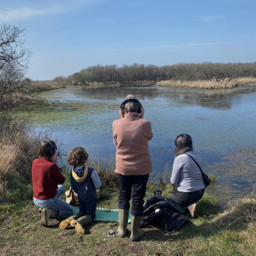
In this sense, recording is not a neutral act of capture but a form of situated attention. Microphones extend perception without physically altering the site, making it possible to register ecological conditions through acoustic presence alone. The land is not sampled or taken-from, but listened to in its own unfolding.
Ecoacoustics also reframes how we interpret what we hear. It is not only about identifying species, but about understanding relationships between sound, space, and ecological health — how soundscapes shift under pressure, how diversity appears as density and variation, and how absence can become audible.
So, listening becomes both ethical and methodological: a way of being with a site without extracting from it, and of understanding ecological change through its sonic expression rather than its visual dominance.
In a crisis shaped by rapid loss and disruption, this form of attention asks something simple but difficult: to stay with what is still speaking, and to recognise that not all knowledge requires intervention in order to be known.
Can you describe what you mean by “multisensorial environmental empathy”, and how that is encouraged through nature field recording?
I describe my work as creating multisensorial environmental empathy. That means expanding perception beyond the human sensorium through ultrasonic insect communication; vibrational movement through soil; and underwater acoustic environments.
Every organism operates within its own perceptual world, what biologist Jakob von Uexküll described as an Umwelt. Micro-organisms, insects, arachnids, they all inhabit radically different sensory realities. Through recording, I’m not translating those worlds accurately – that’s impossible – but offering a trace or impression of their presence, something that shifts our sense of scale and importance.
What does a collective deep-listening practice look like for you?
Collective listening becomes a kind of temporary reorientation. When people sit together in a space and listen deeply, the hierarchy of attention changes, human voices are no longer central and subtle environmental sonic detail becomes dominant. It creates a shared experience of decentring, even if only briefly.
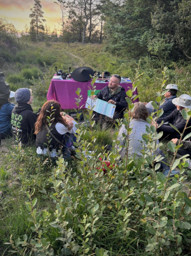
Alongside this, I run monthly in-person listening sessions called Sound & Sense, with Kate Paxman, a post-disciplinary artist and researcher. At these sessions, a small group gathers to listen to a field-recording album together over the course of an hour.
We gently guide participants through a focused listening activity, encouraging attention to texture, space, and perception, and then open up a discussion around what was experienced. What’s important is that it’s not about analysing or explaining the sound, but slowing down perception, noticing how listening shifts over time, and becoming aware of how each person hears differently.
These sessions often reveal just how subjective and unstable listening is, and how quickly we can move away from a human-centred mode of attention into something more distributed and ecological.
It also begins to build a kind of environmental empathy – not as a concept, but as a felt shift in relation. When attention is held long enough, people start to sense that the environment is not a backdrop but an active, expressive field of signals happening at multiple temporal scales.
This includes a heightened awareness of temporal listening, the way different lifeforms occupy radically different timeframes of sound. For example, many birds communicate in extremely rapid sequences of calls and phrases per second, layered and overlapping in ways that exceed human perceptual parsing. We don’t ‘miss’ them in a simple sense; we are not structurally tuned to resolve them as discrete events in real time.

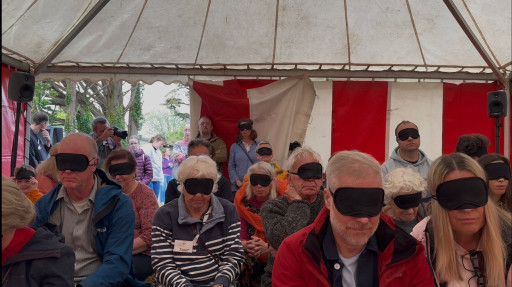
Listening together over extended periods makes these differences in temporal resolution more apparent. What first appears as a single continuous birdsong can begin to resolve into dense, fast-moving structures of communication, activity, and response.
In that sense, the practice becomes not only about listening more closely, but about recalibrating what ‘present time’ means in an ecological context, where multiple rhythms coexist and attention itself becomes a way of sensing the layered speeds of the more-than-human world.
Can sound artists who focus on nature and our relationship to the environment benefit the general public’s ability to listen to the more-than-human world?
I think sound can bypass a lot of resistance. Instead of telling people what to think, it lets them encounter something directly. But it’s important not to sanitise or aestheticise too much because there’s a risk of turning the ecological crisis into something pleasant or consumable.
The work has to hold tension, beauty, unease, fragility. That’s where real engagement happens.
In your experience with the public and as an educator, what, generally, are the aspects or tools that most capture people’s interest in nature sounds?
Moments where perception breaks: hearing bats in ultrasonic range; internal vibrations of trees; or ground movement through geophones. These create a realisation that this world has always existed, but that I’ve been excluded from it. That shift is often immediate and quite profound.
I am always surprised, when I do outreach days with nature organisations, that people spend a long time listening to fairly abstract soundscapes like the sound of plant photosynthesis underwater or insects stridulating. These dynamic sounds surprise me every time I go out in the field and that’s one of the reasons I keep going out and listening for long durations: to hear sounds I never heard before in the living world.
Can you describe the process of the recording ‘Vibrational Arachnid Soundscape, Radford Quarry, Plymouth, UK, 2024’?
My work at Radford Quarry became explicitly political. This is one of the only known habitats of Nothophantes horridus, an extremely rare spider species existing in a very specific subterranean environment. Part of that habitat has already been destroyed through development, and there are ongoing attempts to reframe the site as an eco leisure space.
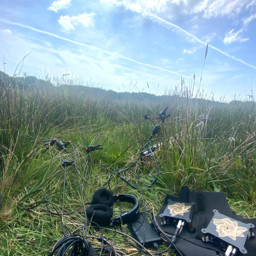
The language of sustainability is being used, but the reality is increased human presence, increased vibration, light, and disturbance, and a reframing of the site as something to be used and consumed. From the perspective of the spider, a vibration-sensitive organism, that’s not neutral – it’s potentially catastrophic.
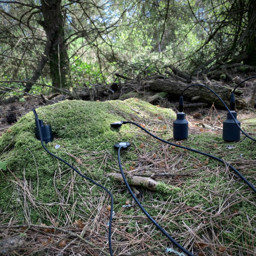
I used geophones to capture subterranean vibration, and ambisonic microphones to capture the 3D environmental field above ground. The idea was to move away from a human-centred perspective and instead construct a layered perceptual field. What you hear is not the spider itself, but the vibrational conditions it depends on, the spatial atmosphere of its habitat, and the fragility of that system.
It’s an attempt to listen towards another world, while acknowledging we can never fully access it.
How do you collaborate with scientists and what have been the specific outcomes?
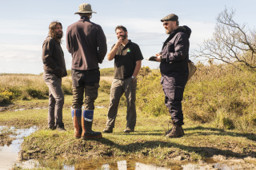
I work with organisations like Natural England, where scientific knowledge helps me guide where to record, what to pay attention to, how ecosystems function, habitats of species and environments, and when best to record. But the role of the artwork is different. Science can identify and measure loss; art can make that loss felt and experienced.
The outcomes exist as public-engagement days through listening posts and sound walks identifying different habitats and ecosystems, to start to create a sonic map of a particular area.

And how do you unite this work with artistic practice?
For me, it’s not about illustrating science, it’s about creating a space where people can directly encounter complexity without everything being explained or reduced. That’s where art can be powerful: it allows uncertainty, ambiguity, and non-human presence to exist without being resolved.
Would you like to mention any current or future projects?
I’m currently working on a long-term project with Natural England, recording across protected landscapes, including Goonhilly Downs Site of Special Scientific Interest (SSSI) and ancient woodland systems. This will be toured throughout the UK in major venues as an ambisonic sound installation. Its focus is on long-duration listening, environmental change, and building immersive installations that bring people into close contact with these ecosystems.
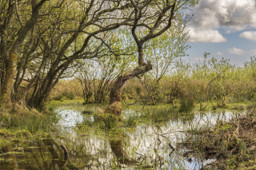
Alongside this, I am developing a sound installation that explores the underground world of soil as a living acoustic system. This work shifts attention away from the visible landscape into sub-surface processes, root networks, microbial activity, invertebrate movement, and the slow exchanges that structure terrestrial life.
The installation is designed around low-frequency sound fields, using sub-bass arrays and tactile transducers (‘activators’) to translate subterranean activity into vibration and pressure rather than conventional audible detail. Much of the work operates at the threshold of hearing, where sound is not only heard but physically felt through the body, as resonance, weight, and subtle motion.
Rather than representing soil as a metaphor, the aim is to treat it as an active sonic environment in its own right: layered, responsive, and continuously in flux. The emphasis is on embodied perception, where audiences encounter ecological systems not at a distance, but through direct physical immersion in vibration.
In this sense, the installation extends my broader practice of ecoacoustic listening into the ground itself, revealing a hidden temporal world that operates at different speeds and intensities than surface life.
I’d like my recordings to open up a space to think about how listening might shift our relationship to environments that are increasingly under pressure, and whether we’re willing to protect worlds that don’t belong to us, and that we may never fully understand.

🎧 Listen to Jamie House‘s work on Earth.fm
Contact:
Website: www.jamiehouse.co.uk
Instagram: https://www.instagram.com/j_aime_h/
Soundcloud: https://soundcloud.com/jamiehouse
His book: Transmissions
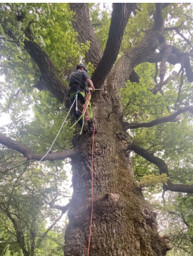
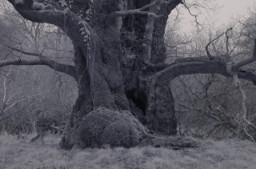
Featured photo illustrates using specialist tree probes to listen to microscopic sounds of sap flow and xylem running through trees.This sound was then diffused and spatialized for a 10-speaker ambisonic immersive soundscape.
All photos courtesy of Jamie House
Earth.fm is a completely free streaming service of 1000+ nature sounds from around the world, offering natural soundscapes and guided meditations for people who wish to listen to nature, relax, and become more connected. Launched in 2022, Earth.fm is a non-profit and a 1% for the Planet Environmental Partner.
Check out our recordings of nature ambience from sound recordists and artists spanning the globe, our thematic playlists of immersive soundscapes and our Wind Is the Original Radio podcast.
You can join the Earth.fm family by signing up for our newsletter of weekly inspiration for your precious ears, or become a member to enjoy the extra Earth.fm features and goodies and support us on our mission.
Subscription fees contribute to growing our library of authentic nature sounds, research into topics like noise pollution and the connection between nature and mental wellbeing, as well as funding grants that support emerging nature sound recordists from underprivileged communities.