


French, Paris-based sound engineer, naturalist recordist, and photographer Thibault Noirot supports Earth.fm because “It treats a soundscape as a life, not just a file.
“At a time when anthropophony is quietly drowning biophony, giving people a place to truly listen, closely and patiently, to the more-than-human world feels essential. Earth.fm is that place, and I’m proud to help point people toward it.”
He kindly agreed to find some time in his busy schedule and chat with us about his many projects and his interest in the natural world.
Can you summarize the path that led you to learn about nature sounds?
I actually saw sound for the first time when I was 16, during a Chladni-figures experiment at the Lycée Cuvier in Montbéliard, eastern France. A violin bow drawn across the edge of a metal plate, sand moving to map out the nodes and antinodes of a standing wave. Sound became visible, measurable, and structured. My entire journey since, from the Chalon-sur-Saône conservatoire to the ENS Louis-Lumière, and from film post-production to audio development, has been about staying true to that initial intuition: sound is not just something we hear, it is something we can analyze, transform, and make people feel.
My master’s degree at Louis-Lumière served as an unlikely detour that bridged this technical approach with the natural world: a sonic reconstruction of the château de Montbéliard. This archaeology of the soundscape, carried out under Mylène Pardoen, taught me how to make a vanished world audible again. I then spent years in film post-production and built a vocal-morphing tool, Morphosis, which maps the spectral signature of one sound onto another and now lives with Polyson/HAL Audio.

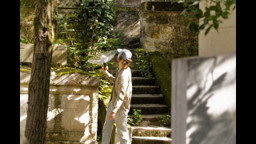
Yet, I kept being pulled out of the studio. As a naturalist photographer, I spent five years documenting the wildlife of a single Paris quarter around the Père-Lachaise cemetery, keeping a microphone right beside my camera. (The resulting photo series won the Paris Nature prize in 2025.) Out in the field, I felt what every recordist eventually feels: what reaches our ears is only a tiny fraction of what the physical signal actually holds.
From there, it was a short step to wanting to apply my background in spectral analysis and acoustic reconstruction to a more urgent matter: archiving, analyzing, and recomposing the voices of species in decline. My path ultimately runs from the studio to the field, and from reconstructing a vanished past to trying to hold onto a present that is quietly slipping away. This realization is the core foundation of my current project, Ce qui se tait (What Is Silenced).
What entices and excites you about listening attentively to nature sounds?
The gap between hearing and the signal. To hear a blackbird is to hear a surface; to analyse its signal is to discover an architecture. A bird has no vocal cords, it sings with a syrinx at the fork of its bronchi, which lets some species emit two sounds at once. There are harmonic stackings and micro-temporal modulations of infra-sensory precision that the naked ear simply can’t reach. Attentive listening, for me, is the doorway into that hidden architecture. Listening closely is realizing you have stepped inside an orchestra that was tuning itself long before us.

What has listening taught you about the more-than-human world?
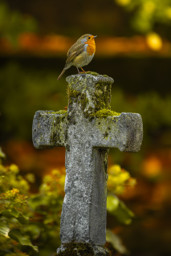
Humility; that we are one voice among many, inside the chorus rather than above it, as Vinciane Despret and Baptiste Morizot keep teaching. Listening has also taught me that extinction is rarely a clean silence. A forest that recedes is not replaced by emptiness; it is recolonized and homogenized, often by poorer, more uniform, more mechanical sounds. As the palaeontologist Bruno David puts it, the living never disappears entirely, it recomposes – and that is far more unsettling than a simple void. Finally, it has taught me that the threshold of the audible is arbitrary: recent work from the Hadany Lab shows that plants emit ultrasounds under hydric stress [demand for water]. Most of what matters is happening just past the edge of our hearing; listening is learning to take that seriously.
Can you name the three field recording works you like the most?
David Monacchi’s Fragments of Extinction, and the film Dusk Chorus that grew out of it: high-definition archives of primary forests on the edge of disappearing; the closest precedent to what I am trying to do. Ambiances and Images, by Knud Viktor, a Danish naturalist who listened to a single hillside in the Luberon, Southern France, for decades; his patience is a whole ethic in itself. And among my contemporaries, Mélia Roger’s audio-visual installation Dear Phonocene and the short film Intimacy of Lichens: a fine-grained way of listening to the non-human and the inanimate alike, where the matter itself is shared, from animals to lichens to stones.

You listen to and record nature in cities and urban spaces. What could be improved in order to balance both human and more-than-human lives?
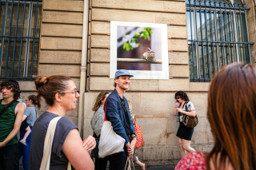
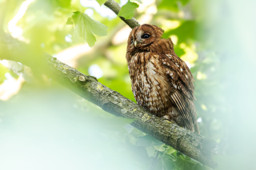
Cities are where the contest is most audible. The blackbird is a textbook indicator of acoustic anthropization; it raises its pitch and sings at night to be heard over us. The first thing is simply noise: anthropophony is steadily drowning biophony, and we still treat sound as the last pollutant we bother to measure. We could design for quiet acoustic refuges, dark and silent corridors, and treating green spaces and even cemeteries as the refuges they already are. I record one daily, the Père-Lachaise, where a tawny owl nests a few hundred metres from the traffic. More deeply, we could let listening inform planning: ask what a place sounds like to its non-human residents before deciding what to build there. Quiet is not a luxury; quiet is habitat.

How do you see current technology playing a role in natural soundscapes and animal sounds? Do you see negative sides to it?
I use AI every day as an augmented ear: BirdNET/MerlinBird to ask which species; Perch to ask which sound structure, to find a single voice inside thousands of hours of archive. But it extends listening, it does not replace it; presence on the ground stays the judge of peace, as Jérôme Sueur puts it. The danger is twofold. First, the same datafication that lets us monitor can disembody what it measures: a soundscape becomes an index, and we forget it was a life. Second, technology is also the source of the problem: the ‘technosphere’, the infrastructural hum of roads, mines, and satellites, is now part of every territory’s acoustic signature, often below the threshold of hearing; Jonathan Larcher’s fieldwork in Sápmi [the region traditionally inhabited by the Indigenous Sámi people, spanning Norway, Sweden, Finland, and Russia] names this well. The tool that documents the disappearance is a close cousin of the one that causes it. I try to hold both in the same frame, rather than choose.
What would you like to record someday?
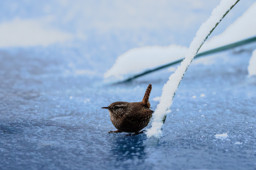
The boreal lynx. Here, it is a ghost species, almost never heard, on the very edge of presence. I am interested less in capturing it than in recording its near-absence: the listening of the absent, a habitat shaped like a hole. More tangibly, I keep returning to the frozen lakes of the Jura Mountains [primarily on the French–Swiss border] and Switzerland: a contact mic laid on the ice, listening to the tensions of a frozen surface, a non-living matter that turns out to be deeply acoustic. And someday, a primary forest at dawn, while it is still a place and not yet an archive.
Where can people connect to you and learn about your work ?
My sonic explorations live on Instagram at @lasciencemusicale, and my wildlife photography at @eko_thib. My composition and sound work runs under La Science Musicale, and the tool behind much of it, Morphosis, is with Polyson/HAL Audio. And now, of course, you can find me listening on Earth.fm.


Bio:
Thibault trained at the École nationale supérieure Louis-Lumière film school and currently works at Polyson, where he contributed to the sound of award-winning films including Anatomy of a Fall (winner of the Palme d’Or at the Cannes Film Festival in 2023) and All We Imagine as Light (winner of the Grand Prix at Cannes 2024). He is also the creator of Morphosis, a spectral voice-morphing tool published by HAL Audio.
For five years, he has documented the wildlife of a single Paris quarter, around the Père-Lachaise cemetery, with both camera and parabolic microphone – work that won the 2025 Paris Nature prize. ‘Seeing Birdsong’, his collaboration with artist Lucio Arese, sculpts a linnet’s song in 3D, and has been viewed over eight million times.
He also runs La Science Musicale, a community of over 100,000 followers exploring the living world and its transformations, while his current project, Ce qui se tait (What Is Silenced), uses spectral analysis and acoustic reconstruction to archive, analyse, and recompose the voices of species in decline.
All photos courtesy of Thibault Noirot
Earth.fm is a completely free streaming service of 1000+ nature sounds from around the world, offering natural soundscapes and guided meditations for people who wish to listen to nature, relax, and become more connected. Launched in 2022, Earth.fm is a non-profit and a 1% for the Planet Environmental Partner.
Check out our recordings of nature ambience from sound recordists and artists spanning the globe, our thematic playlists of immersive soundscapes and our Wind Is the Original Radio podcast.
You can join the Earth.fm family by signing up for our newsletter of weekly inspiration for your precious ears, or become a member to enjoy the extra Earth.fm features and goodies and support us on our mission.
Subscription fees contribute to growing our library of authentic nature sounds, research into topics like noise pollution and the connection between nature and mental wellbeing, as well as funding grants that support emerging nature sound recordists from underprivileged communities.