


Whatever it was was moving, and moving fast. It sounded like a freight train; I couldn’t see it,
but I could hear it, and it was coming this way. The thing is, it was about three centimetres long
and moving through the soil, about 16 centimetres below my feet. It was a grub, the
unidentified larva of an unidentified beetle.
Removing my headphones and standing, I walked about three meters away, toward a small
orange flag stuck in the ground. It marked another listening site, a place closer to a nearby
stream where I had detected earthworm activity. Attaching my recorder to the probe inserted
into the ground alongside the flag, I put the headphones back on and listened. Sure enough, I
could hear the telltale sounds of earthworm setae, the coarse bristles that propel the worms’
bodies through the soil via muscular contractions. It sounded like someone…slowly grinding
their nails on an emery board.


Welcome to the bizarre world of soil bioacoustics.
I found myself pulled into this odd little corner of wildlife sound recording when I was asked to serve as the consulting acoustic biologist for a project near my home here in Vermont. The state is heavily forested, and its deep, rich soils support a wide range of flora and fauna—including invasive species that wreak havoc on indigenous organisms. Plant invasives, such as Japanese knotweed, are particularly problematic: not only do they rapidly grow out of control, choking out local species, they also release allelopathic chemicals into the soil that prevent other species from germinating and growing—the ecological equivalent of a hostile takeover.
Soil ecologists like to observe that “noisy soil is healthy soil.” My role in the project was to use bioacoustic techniques to determine the presence of microfauna in the ground. Even the smallest soil organisms are remarkably noisy: larvae scratch and hiss; earthworms sound like, as I said earlier, nails being filed; termites bang their heads against rotting wood; and ants stridulate in high, squeaky voices. And those are just the ones we can conclusively identify. Unfortunately, there is no “Merlin for Insects” app, especially for those Japanese knotweed, growing in profusion along the Mad River in Vermont that live below the earth’s surface. To be sure, there are sound databases scattered across myriad universities and research institutions, but there is no single go-to place for insect voice analysis.
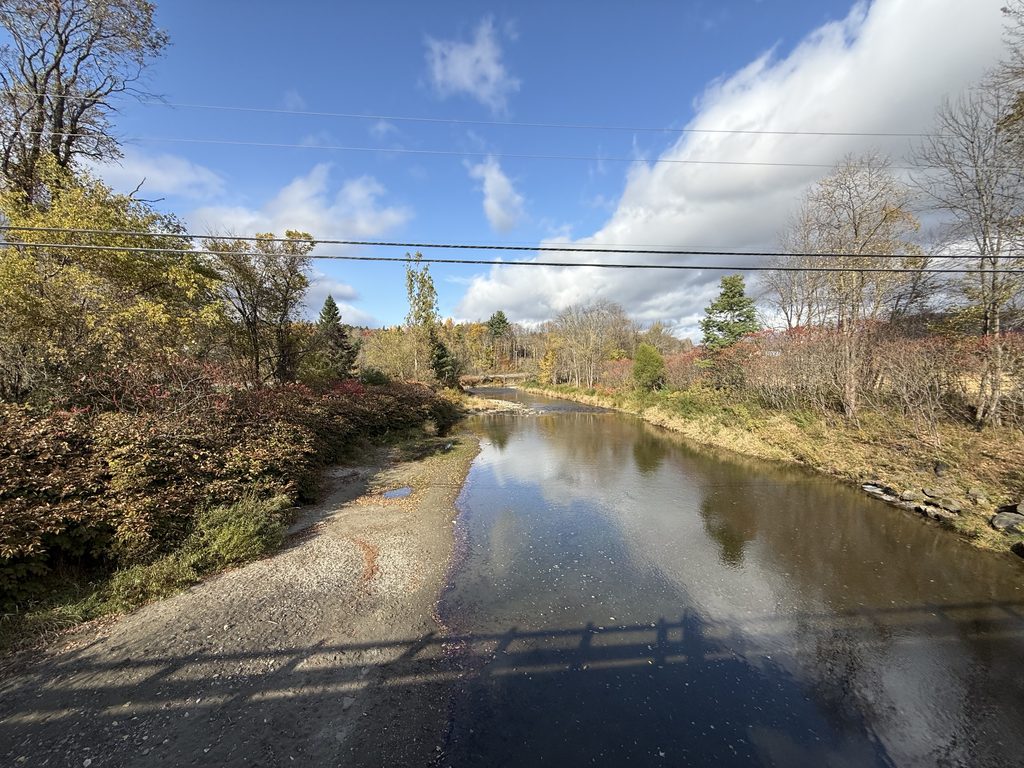
A view of the Mad River, showing an infestation of knotweed on the left. The right bank has been physically cleared of the invasive plant by volunteers.
For the purposes of the study, we selected six listening sites, all geographically close but
physically separated by about a kilometre. Three of the sites were completely free of invasive
plant species; three were overrun with them. My goal was to compare the “soil soundscapes” of
the six sites, using subterranean acoustics as an indicator of ecosystem health through the
presence or absence of sounds generated by soil organisms, and then compare the sounds of the plots with invasives to those without and listen for telltale differences.
I relied on my Sound Devices MixPre 6-ii as my main recorder, with a Zoom H6Studio serving as backup. Both have exceptionally low self-noise, critical for recording sounds that are low-
level to begin with.
As for microphones, I had options, and I intended to use all of them. First, I had a set of JrF hydrophones—basically, waterproof contact mics—that would work well for the riparian regions of the plots I was to assess. I also had a geophone sold by Barcelona-based Mutan Monkey Instruments (excellent device, by the way), and another geophone, custom-made by fellow
recordist and WSRS member Dick Todd, also an excellent mic.
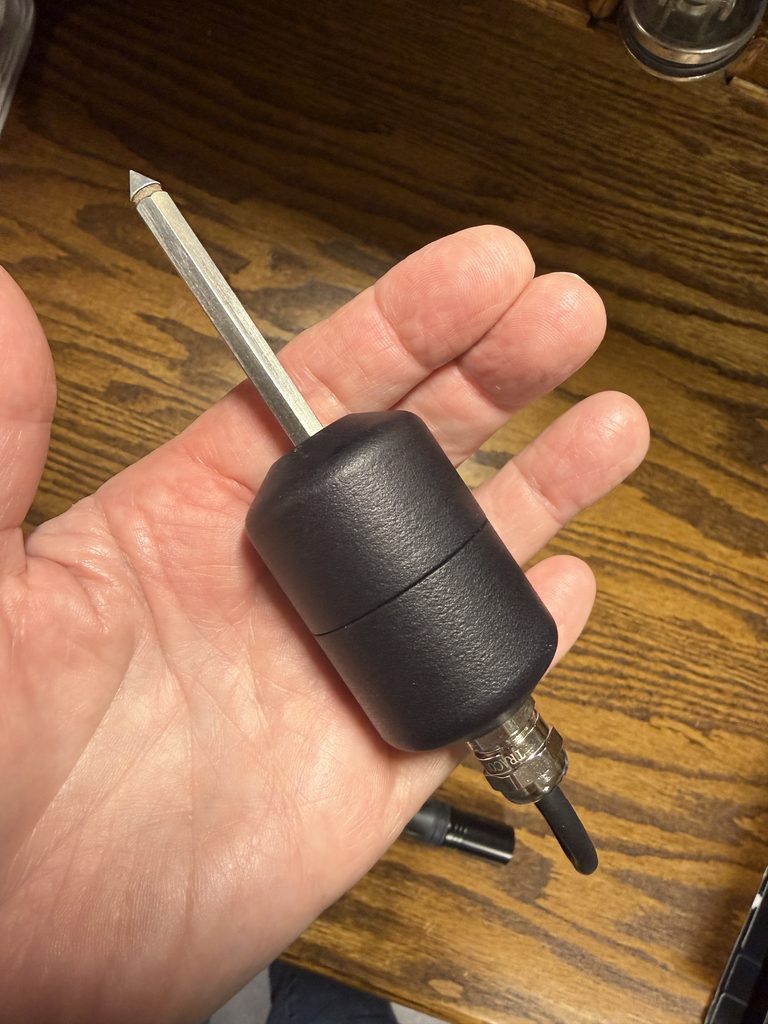
A geophone by Barcelona-based Mutan Monkey.

Todd.
These were great choices for spot recording, choosing an area and capturing in real-time as I listened to the headphones for sonic events. But I had two challenges: first, geophones have a frequency response that tends to be on the very low end of things, which is great, but I also needed something that would respond to the midrange. Second, I wanted to record multiple locations in each of the test plots simultaneously, over the course of several hours and at different times of day—which meant leaving the gear in place and coming back for it several hours later or in some cases, the next day. This was important, because walking around, I discovered, makes noise that the mics detect, so I had to be elsewhere. I could secure the recorder(s) without an issue by locking them in a secure waterproof box, but the mics were a different story. I wasn’t going to buy a dozen expensive hydrophones or geophones for a single project; the costs would add up very quickly. So instead, I decided to build them.
The results far exceeded my expectations. In the end, I built 12 extremely sensitive probe microphones that yielded audio treasure. And the total cost for the dozen mics? US $55 (44 GBP) —or, US $4.58 per microphone. Here’s how.
Given that my goal was to record evidence of the presence (or, conversely, absence) of
organisms moving through the soil, I decided that while the hydrophones were fine for the
riparian areas alongside stream margins, a specialized contact mic would be a better choice for
the open field areas. So, after speaking with a handful of local farmers, a couple of soil
biologists, and a local soil entomologist, I designed and built a prototype.
Here’s what I knew. First, healthy soil is not quiet. The sounds found there, however, are low-
level, which means that a recorder with good preamps and low self-noise are crucial.
Second, sounds do travel through soil, but the degree of propagation varies greatly because of a number of factors including soil makeup (organics, sand, clay, water, etc.), degree of soil compaction, moisture content, etc.
Third, sound waves traveling through soil do so because they’re in direct contact with it, which
means that the pickup device must be in direct contact with the soil.


Fourth, I found that all of the mics yielded results of different kinds. The JrF hydrophones worked well in very wet areas. My two geophones, one from Dick Todd and one from Mutan Monkey, responded well to low frequency signals. But as I mentioned, I also needed a device that would capture sounds in the medium range of frequencies.
Finally, the ability to positively identify whatever is making the sound being recorded is haphazard at best, because vision has no role here. Yes, you can grab a shovel and massively disrupt the sound environment, but even then, connecting a specific sound to a specific organism is daunting. But that’s the fun part, isn’t it?
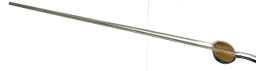
I started with a 5 cm piezoelectric disk and a 25 cm iron rod, about 0.3 cm in diameter. Using a clear acrylic cement, I bonded the all-metal side of the disk to the rod, about 2.5 cm below the end. In theory, vibrations striking the rod would be carried to the disk, which would pass them on to the recorder.
Once the glue was dry, I wired one meter of shielded audio cable with a standard 0.63 cm mono plug on one end to the leads attached to the disk. After covering the wires with a sticky felt chair pad the same size as the piezo disk to serve as a strain relief, I dipped the back of the disk into liquid rubber, securing the wires and attaching them, along with the pad, to the disk, creating a solid unit. I applied a second coat, then left the contraption to dry.
Next step? Test the unit. Inserting the microphone’s plug into the connector on my MixPre, I
turned on 48V phantom power and adjusted the channel gain to a relatively high level. I then
went out into the back garden in the early morning hours and carefully pushed the rod into the
soil. I put on the headphones, and listened.
It had rained the night before, and apparently the earthworms had declared it a national
holiday, because they were out in force. The headphones were filled with the scratchy sounds of
setae pushing the worms’ muscular bodies through the rain-soaked soil. The robins were out in
force as well, pulling earthworms from the ground nonstop on the other side of the garden, like
toddlers eating spaghetti.

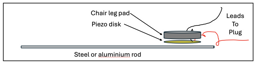
A couple of observations for those of you who are considering building your own, as I did. First,
you’ll notice that I mounted the disk slightly below the top of the rod. This is to provide a bit of
space so that when I push on the rod to insert it into the ground, I don’t also push on the disk,
which might dislodge it.
Some of the literature I reviewed observed that aluminium rods have better sound conduction capabilities than iron or steel. I tried both, and was unable to detect a difference.

Finally, patience is the watchword here. I’ve used this design to record in soil, beach sand,
stream beds, compost piles, ant nests, and rotting trees. I’ve had good results in all of these
natural media, but obviously, not every time. Sometimes, there’s simply nobody home. As far as
the formal study is concerned, that wasn’t a bad thing. As I noted earlier, noisy soil is healthy
soil, and ultimately I determined that in the areas where invasive botanicals were not present,
the soil was cacophonous—okay, as cacophonous as soil gets. But in areas where invasives had
gotten a foothold and were releasing allelopathic compounds into the soil, silence reigned. A
new neighbor moved in; everybody else moved out. Was this definitive proof that the invasives
had eliminated their biological competition? No, but it did provide additional evidence that in
areas where invasives were richly present, the soils, without exception, were acoustic deserts,
devoid of a significant amount of life. Coincidence? I don’t think so.
All photos courtesy by Steven Shepard
Featured photo: Listening to the sounds of the soil in a farm field that has no invasive presence.
Earth.fm is a completely free streaming service of 1000+ nature sounds from around the world, offering natural soundscapes and guided meditations for people who wish to listen to nature, relax, and become more connected. Launched in 2022, Earth.fm is a non-profit and a 1% for the Planet Environmental Partner.
Check out our recordings of nature ambience from sound recordists and artists spanning the globe, our thematic playlists of immersive soundscapes and our Wind Is the Original Radio podcast.
You can join the Earth.fm family by signing up for our newsletter of weekly inspiration for your precious ears, or become a member to enjoy the extra Earth.fm features and goodies and support us on our mission.
Subscription fees contribute to growing our library of authentic nature sounds, research into topics like noise pollution and the connection between nature and mental wellbeing, as well as funding grants that support emerging nature sound recordists from underprivileged communities.

