


Nature has helped me to find solace, even within loneliness. Nature doesn’t require me to be performative; it forces me to trust myself and the surrounding environment.
Even when experiencing uncanniness in nature, we then seek beauty to find safety: fragrances, sounds, textures, sensations on our skin, whether gentle, strong, or unpleasant, are all there to be embraced.
Finding focus in the natural world
In nature I am listening to an honest display of life, a non-performative act, I learn to listen deeply to both myself and to others, whether human or more-than-human. I’m working to listen to nature with more knowledge and openness.
Nature isn’t a hierarchical system, like a government or a monarchy; it requires nothing but our bodies.
The more I went outside, the more I started to feel this. Throughout 2024, from the end of summer until Christmas day, I spent a lot of time outdoors and recorded a lot. I felt strongly that I could be myself, in a somewhat relaxed state; I didn’t have to perform. It’s a very honest relationship, because nature is not asking that from us. It’s not asking us to pretend.
And I’ve found a humbleness that speaks through my act of listening, quietly and unpretentiously.

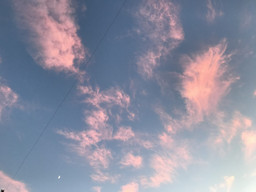
We don’t need microphones, nor apps, just to pay attention to what’s going on: two crows dancing against the lilac sky, a beautiful moth on a thistle, the hypnotic swirl of wind on faraway trees, a line of ants nearby on the ground, sound reflecting off of surfaces. The rustle of your jacket when you move.
These spaces – when they occur both in your mind and outdoors, when you feel safe – allow and welcome everything: grief, love, joy, desperation, sadness, agitation. You pave a way to encounter yourself when you let the outdoors open space in you.
Contemplating sounds
I often think and share my thoughts publicly regarding the way our focus (seemingly ever weaker and more ephemeral) literally went down to the screens of our portable devices – even when we are witnessing a mesmerizing sunset, or are lucky enough to see a roe deer or to hear the persistent begging of woodpecker chicks emerging from a perfectly carved circle on a tree.
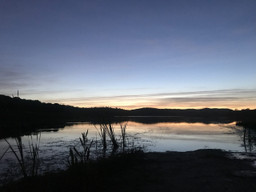
During the summer of 2024, while drying after a swim, I was reading Karen Armstrong’s Sacred Nature. In the introduction, Armstrong describes how, as a young nun studying to enter university, she visited the British Museum in the 1960s to see manuscripts from the 18th and early 19th centuries on display. She describes her experience of “time […] seem[ing] to collapse”, continuing that she “simply wanted to be in [the manuscript’s] presence. It was a kind of communion.” By comparison, “[visitors today] seem […] impelled not just to look but to take photographs […]. They do not seem to want simply to commune.”
I apply these thoughts to natural sounds: a variety of birdsong and calls; plants rustling, excited by the wind or an animal passing; lake edges lapping, water bubbling, insects buzzing, frogs croaking; blackbirds inspecting ground covered by fallen leaves – all shaped, to some extent, by the geology of their habitats, with likely adaptations to anthropogenic impacts.
In my interviews, I have mentioned being a relatively agitated person unable to meditate in the way we are usually advised. But: curiosity about our earthly companions and the mysterious forests of Sweden gently nudged me onto a path I simply can’t stop following”?. In many ways, this has taught me about contemplation.
So, despite conventional meditation still triggering agitation and impatience, for the past eight years or so, I have rarely had problems remaining still, mentally or physically, while listening and contemplating. Through this, I have been able to tune myself to the sounds produced by dragonflies, the interaction between gorse shrubs and the wind – and how that is much closer to the sounds of needleleaf trees rather than the sound of a fig tree, for example, or the meditative sound of a cormorant gently floating and diving the waters for a long period of time.
This attunement has also allowed me to identify intrusive species by ear. For example, Antipodean eucalyptus trees are widespread in the Mediterranean ecosystem. They are associated with soil toxicity, deadly fires, and corporate profit. One day, sitting by a lake I often visit, the wind lightly touching my skin. Blowing from a stand of eucalyptuses planted on the crest of a hill and abandoned to grow uncontrollably, it was distinctly audible. These trees aren’t part of the natural soundscape here, and – by comparison to the sturdy oaks and olive trees which evolved in the region and have been nurtured over millennia – they made a ruckus.
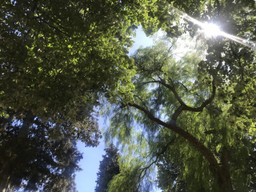
In his modern classic of media theory, The Society of the Spectacle, Guy Debord writes that the “spectacle is a social relationship between people that is mediated by images”, and which alienates us from our direct life experience.
When I started to notice myself and some friends perceiving their natural surroundings mostly via their phone camera, many times the interaction was short and superficial. Without a phone, I realised I was contemplating for no other reason that what just is or, at the most, curiosity, sometimes fascination. It is lived in the present, rather than saved for some brief second in the future, as a two dimensional memory, without sensation, or smell, or sound.
At the other end of the spectrum, we must strive to engage, listen, and allow real experiences to permeate us – the opposite of living fast, scrolling every five seconds, and further reducing our awareness of our surroundings.
The ear becomes trained effortlessly, it evolves into recognizing more and more sounds, aggregating patterns and expanding our internal database. It is a powerful form of knowledge, both external and internal, which allows me to direct my attention to something occurring outside of my mind, for long periods; something alive that is as much a part of the world as I am.
To witness an environment change, and to feel grateful that a sunset happens every day but is never the same, makes my world bigger and my days more peaceful.
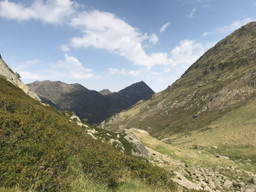
All photos courtesy of Melissa Pons
Earth.fm is a completely free streaming service of 1000+ nature sounds from around the world, offering natural soundscapes and guided meditations for people who wish to listen to nature, relax, and become more connected. Launched in 2022, Earth.fm is a non-profit and a 1% for the Planet Environmental Partner.
Check out our recordings of nature ambience from sound recordists and artists spanning the globe, our thematic playlists of immersive soundscapes and our Wind Is the Original Radio podcast.
You can join the Earth.fm family by signing up for our newsletter of weekly inspiration for your precious ears, or become a member to enjoy the extra Earth.fm features and goodies and support us on our mission.
Subscription fees contribute to growing our library of authentic nature sounds, research into topics like noise pollution and the connection between nature and mental wellbeing, as well as funding grants that support emerging nature sound recordists from underprivileged communities.